

Lesson: Water Quality and Turbidity

Lesson: Water Quality and Turbidity
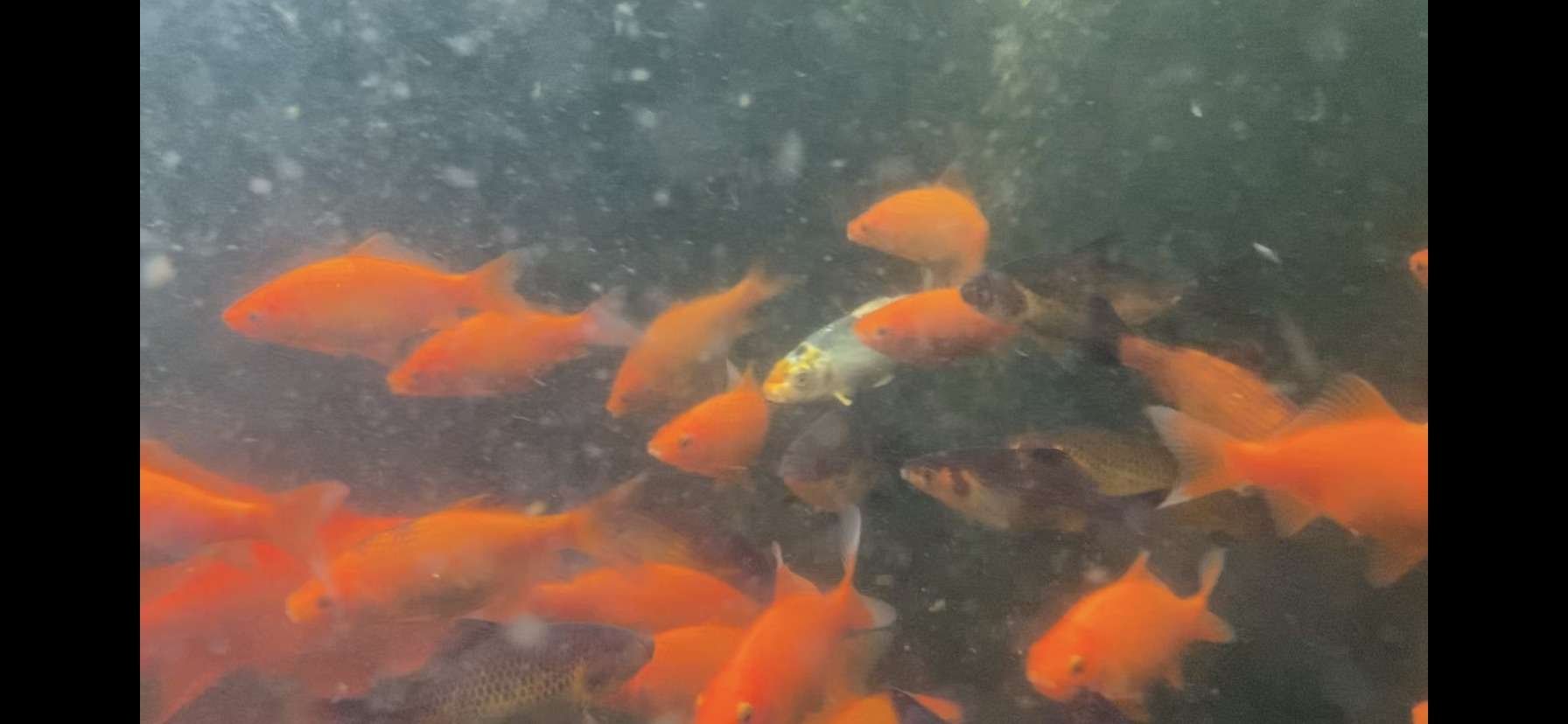
The view of the fish from within the pond.
This is a fun lesson: Water Quality and Turbidity. It uses a simple waterproof camera, iphone, android phone, or waterproof endoscope to see the world beneath the surface of the pond. Students are asked to make hypotheses on water health and oxygenation based on modeled parameters.

Water Purification Tower
Important topics to cover are turbidity and nitrate-nitrite balances, oxygenation, and balanced ecologies. Students will not only observe the environment directly, they will also collect samples ain a controlled study. Then using the scientific method they will determine the health of the water.
A Note on Ph Testing Strips
You can use store-bought Ph Testing strips. They are convenient and cheap. But it makes a better lesson if you ask students to create their own Ph test strips using Universal reagent and tissue paper.
Understanding Acids, Bases, and the role of ions is really important in this lesson. If we have access to lichens, we can create litmus paper. By dissolving the lichen and soaking the tissue paper in the reagent, we can create a simple Ph sensor.
Using Vision to Determine Turbidity
Turbidity will refract light in a body of water. By taking an image and determining how much light is being refracted, we can determine turbidity. Turbidity can also be factored by collecting water in a jar and allowing whatever is suspended in the water to settle at the bottom of a jar after a period of time.
Materials
Pond (preferably with fish)
A camera (see notes)
PH and pond testing strips
At least four sterile lidded clear control bottles
A powerful source of light
A plastic pipette
White tissue paper
A Turbidity graph
A string with a weight - or a measuring tape with a weight
A way of getting accurate measures like a measuring tape
A notebook
Pens and Pencils
Labels for the bottles and collected samples
Instructions
Bring students to the pond. Ask them to observe three to five elements of the pond's ecosystem.
Record those observations in a notebook.
Place into the pond a device for seeing underwater (preferably video) connected to a rod or secured by a string and record short bursts of video from three locations in the pond that are accessible.
Test this apparatus in a sink or tub first!
Losing your phone in a pond is NO BUENO!
A dedicated $30 endoscope is a good choice. It does not give as much dramatic detail as a phone, but is much safer.
Be advised USB endoscopes like this REQUIRE a USB enabled computer, so plan accordingly.
In my experience being able to see the conditions in a pond IN the water really activates students as scientists. It is NOT a requirement, but it will deepen the sense of wonder and excitement for the students.
Record the location of measurement and the depth of the body of water at that measurement.
Collect a sample of water from each site observation in a water container with a lid.
Take measurements of the pond with the PH pond testing strips.
Return to a lab. Observe rested samples of water, Do students observe clear water or is there floating material?
Using the turbidity chart, ask students to identify turbidity at each location.
Graph turbidity conditions, depth, temperature, and PH on a chart.
Using a plastic pipette ask students to carefully pull samples of water from the labeled bottles.
Empty pipette onto white tissue paper and label the droppings.
Allow the droppings to dry and ask students to observe the tissue drops through a strong light.
Ask them what they see. Then ask them to explain their findings based on their collected data.
Learning Outcomes
We want students to infer relationships between volume, current, and materials in the water. The clearer the water, the less materials will be floating. But remember! sometimes the current will allow particles to sink to the bottom.
That is what accurately measuring the depth of the pond is essential. The act of measuring the depth, width and length of the pond allows them to understand volume. Disturbing the bottom of the pond potentially disrupts material at the bottom of the pond and reintroduces it into the current.
