

Design Challenge: Fertilizer
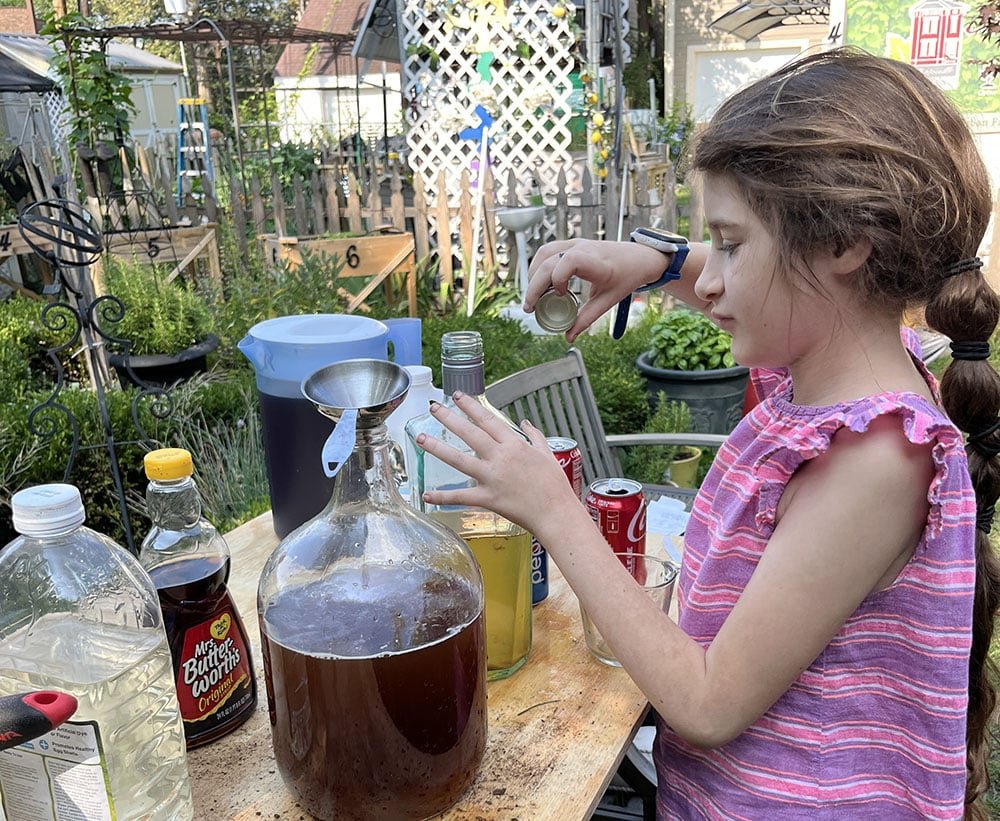
This design challenge will explore the physical aspects of NHCOPS. Nitrogen is key here, as is Phosphus and sulphur. We will be building the main fertilizer used at Mezzacello. Eden's Ghost.
The goal of the design challenge is to introduce kids to the details of fertilizer and natural ecologies.
Each team will get a research station, clipboards, pens, empty and cards that will tell kids how to create a certain fertlizer used a Mezzacello Urban Farm, posterboard and markers. The deliverables are listed under each section.
Running This Design Challenge (One Day)
Introduction to Fertilizer (One Day)
Students must choose a fertilizer from the three selected fertilizer options.
Eden’s Ghost
How to make Eden’s Ghost: (4 hours)
Combine ammonia, syrup, and bacteria beer in a liter container.
Pour this mixture over a compost container full of wet compost.
Allow the liquids to filter through the compost and collect below the compost.
Be ready to catch the liquid!
Repeat the pour over two times.
Reserve the liquid as this is your fertilizer.
BioBlocks
How to make BioBlocks: (24 hours)
Combine aged chicken manure, worm casings, dried algae, diatomaceous earth, and gypsum board into a mixing container.
Add wet comfrey tea to dampen the mixture.
Add mixture to a bioblock mold.
Allow the mixture to dry in the sun or in a dehydrator.
One bioblock is one sample of fertilizer. You must make three.
Charles Chicken’s Algae Eggs CCAE
How to make CCAE: 4 hours
Combine wet algae, rabbit manure, aged chicken manure, comfrey solids, and sawdust together in a mixing container.
Mix well and squeeze out extra liquid, reserve this liquid.
Place wet, but not dripping, mixture into egg molds.
Allow to dry in the sun or in a dehydrator.
One egg is a sample of fertilizer, you must make three.
Make enough for every family to have a sample as well.
Additional Design Challenge Constraints
All three teams must share the resources.
Teams MUST determine how they will store, use, and share their fertilizer.
How will instructions for use be shared as well?
Understanding How Nitrogen and Carbon Work
Each team must conduct research on one of the following three features of water Safety:
What role does Carbon play in the fertilizer? Why is carbon so common? Give discrete examples pulled from research online and from the lesson that day.
What role does Nitrogen play in the fertilizer? Why is Nitrogen so dangerous? Give discrete examples pulled from research online and from the lesson that day.
What role does Potassium play in the fertilizer? Why is potassium so reactive? Give discrete examples pulled from research online and from the lesson that day.
Deliverable: Each team must present a paragraph that describes the fertilizer they have created and a sample card for use and recommedations.
Putting It Together (30 Minutes)
In this section of the Fertilizer Design Challenge, students will be given the fertility testing kits. Each team must provide a sample to another team to conduct NPK testing on their sample. The testing team must work together with a teacher or a MenTern to get valid sample data and record it for the team whose fertilizer is being tested.
They must demonstrate mastery of the testing systems, and biology underlying the fertilizer and relate its importance to plants, people and animals, or mechanical systems that rely on these nutrients.
Presentation
Have each team present their deliverable on a video and give a 30-60 second breakdown on what they learned and created. Have them write the script, film it, edit it and upload it to youTube.
