

Design Challenge: Water Purification
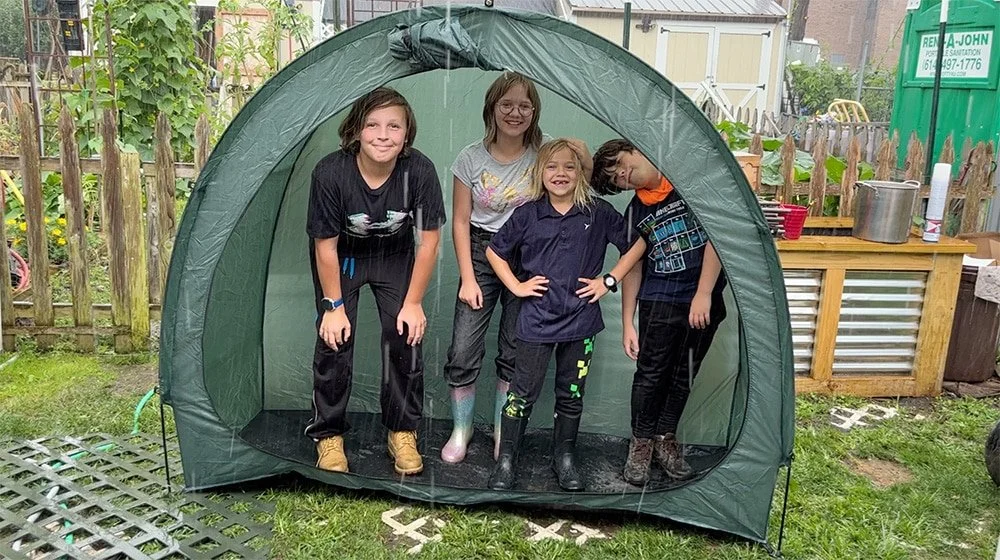
This design challenge explores three routes to collecting, cleaning, and purifying water for human and animal consumption. The three routes will include mechanical filtration, filtration and heating, and using filtration with activated charcoal.
The goal of the design challenge is to introduce kids to the details of water collection, management, purification, and use..
Each team will get a research station, clipboards, pens, empty and clean two-liter water bottles, systems for water purification cantained within this box, posterboard and markers. The deliverables are listed under each section.
Running This Design Challenge (90 Minutes)
Introduction to Water (15 Minutes)
Students must collect a source of water to purify from anywhere at Mezzacello. They must:
Collect at least two one liter samples of water.
Document where and when the water was collected.
Describe in detail what they notice about the water sample.
Test each sample for Nephelometric Turbidity Units (NTU) and PPM impurities.
Record those numbers.
This sample will serve as a baseline (to be labeled baseline) and the purification sample (to be labeled treated water).
Understanding Water, Turbidity, Microorganisms, and Dangers (20 minutes)
Each team must conduct research on one of the following three features of water:
Turbidity and particulate flow
Microorganisms, pathogens, and dangers of water
How nature purifies water
Purification Challenge (1 Hour)
Natural Purification:
This team must create a way using only the simple tools and the research curated from above how to purify water just as nature does.
They are ONLY allowed to use the Natural River Systems or the Solar Distiller provided, no technology.
The water MUST test below 220PPM using a digital water quality meter which will be provided.
The Nephelometric Turbidity Units (NTU) index MUST be below 10.
Deliverable: A poster describing how rivers and lakes purify water AND why spring water is almost always clear.
Mechanical Purification
This team must create a way using only the simple tools and the research curated from above how to purify water as many community systems do.
The addition of an electromechanical distiller, simple centrifuge, and a mechanical pump can be used. They must defend why they want to use these systems and their energy use cannot accrue more than 100watts of power.
The water MUST test below 220PPM using a digital water quality meter which will be provided.
The Nephelometric Turbidity Units (NTU) index MUST be below 5.
Deliverable: A poster describing how cities and municipalities purify water with machanical circulation and distilling.
Electrochemical Purification
This team must create a way using only the simple tools and the research curated from above how to purify water just as aquariums and space stations do.
The addition of an UV light, Heating Unit, Boride, and a mechanical pump can be used. They must defend why they want to use these systems and their energy use cannot accrue more than 300watts of power.
The water MUST test below 180PPM using a digital water quality meter which will be provided.
The Nephelometric Turbidity Units (NTU) index MUST be below 5.
Deliverable: A poster describing how we can purify water chemically, through reverse osmosis, and using chemicals and light
Putting It Together (30 Minutes)
In this section of the Water Purification Design Challenge, students will be given the opportunity to sell and market their water purity and product. Each team must create a compelling use and benefit for their water. How will they use it? Hand washing, plant watering, or animal watering?
They must demonstrate mastery of the systems, and biology underlying the purification of water and relate its importance to people and animals, plants, or mechanical systems that rely on fresh access ton water.
Presentation
Have each team present their deliverable on a video and give a 30-60 second breakdown on what they learned and created. Have them write the script, film it, edit it and upload it to youTube.
